
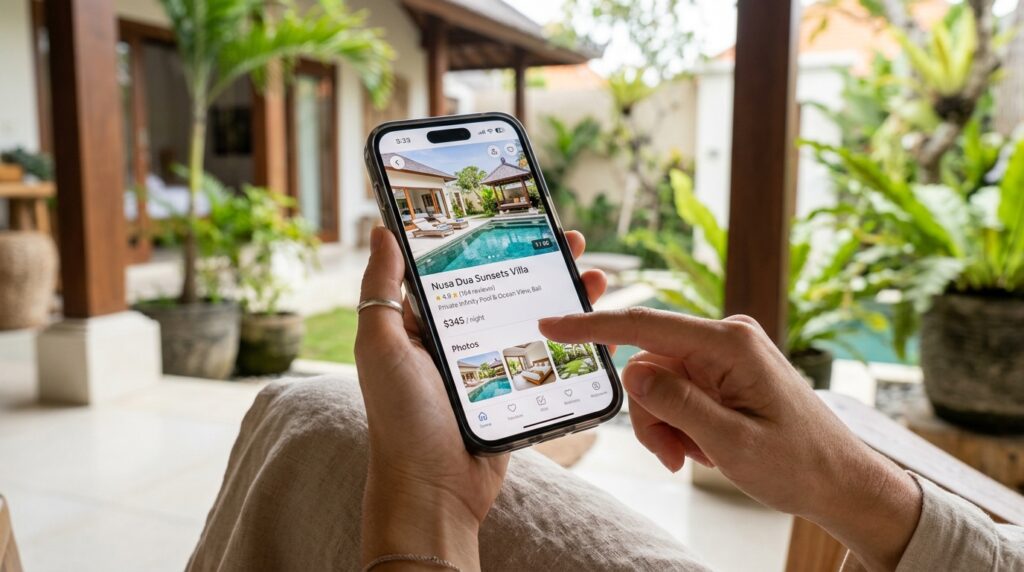
Imagine this: you spot a gorgeous villa in Sanur, the photos look perfect, and you feel that rush of “this is it.” Then the price shows up, the deposit request happens fast, and suddenly you are unsure. What if the place is not exactly what was promised, or worse, what if it is not real at all?
That is exactly why safe villa booking matters. In Sanur, where many decisions happen online and people rely heavily on listings, the two most painful problems are simple: scams (the property is not available or not as advertised) and mismatches (what you get does not match the essentials you expected). You also have to watch for unclear terms, where cancellation rules or included services are not really spelled out.
“Safe booking” is not about being overly suspicious. It is about making sure three layers are solid: the villa is real (property authenticity), the stay is workable in daily life (practical reliability like Wi-Fi, air-conditioning, hot water, pool setup, and staff/maintenance), and your money is handled with transaction protection (clear agreement terms and secure payment practices). When those layers line up, your risk drops dramatically.
In this guide, you will not just read advice. You will learn a controlled workflow: research → verify → communicate → confirm contract → pay securely → prepare for arrival. When you finish, you will know what to ask for and what evidence to look at before any major payment, so you can move from excitement to certainty.
Next, we will define what “safe villa booking” actually means in plain language, and how it protects you from the common failures people run into when booking in Sanur.
If you want a shortcut to verified options, explore vetted stays via Baliexpertvillas.com Sanur villas that fit your needs
Safe villa booking means you’re protecting three things at once: the property, the experience, and your money.
Authentic listing
An authentic listing is one where the villa actually exists and matches what’s being advertised. It sounds obvious, but this is the foundation that stops “ghost villas,” where you pay and the property is never truly available for you to access.
In Sanur, demand can jump during peak periods, and people make decisions quickly based on photos. When that rush happens, fake or reused images work better, so your job is to confirm the villa’s real-world reality before any payment.
Operational fit
Operational fit is whether the villa works well day to day for your specific needs. This includes practical essentials like air-conditioning, reliable Wi-Fi, hot water, pool condition, and how comfortable the living spaces are.
If these details are unclear or exaggerated, you can end up with a stay that feels disappointing, not dangerous, but still disruptive. The point is simple: verifying operational fit reduces the chance of unpleasant surprises that wouldn’t be fixed once you’re already there.
Legal and operational clarity
Legal and operational clarity means the villa is run in a way that is accountable and consistent, not improvised. Practically, it comes down to transparency about rental terms and ensuring the accommodation is legitimately operating rather than existing only as an informal listing.
This matters because unexpected closures are not a theoretical risk. When a property isn’t operating properly, you can lose time and money, and your options to resolve issues shrink quickly.
Payment protection
Payment protection is how your money is handled and what recourse you have if something goes wrong. A safe booking uses a clear written agreement and payment practices that minimize the risk of irrecoverable loss.
When hosts push for unclear arrangements or ask for payment in ways that are hard to trace or dispute, that’s where trouble often starts. Protecting payment is the difference between a problem you can manage and one you might not be able to recover from.
Practical verification
Practical verification is the evidence you collect before committing. Instead of relying only on polished photos, you confirm key details directly through communication and verification steps that check what you’ll actually experience.
In practice, this reduces photo mismatch. When you can validate the villa’s essentials and current condition before paying, you’re not gambling on whether the listing is accurate.
Now that the meaning of safe booking is clear, the next step is understanding the timeline, so you know exactly where to verify and what to confirm before any money moves.
Nothing is scarier than realizing too late that your “booking” offered no real protection. The good news is you can design the process so safety checks happen before any money moves.
OTAs vs local agencies
OTAs can be convenient because they usually handle the booking structure and create friction against the simplest scams. That means you often have a clearer path when something doesn’t match expectations, and you are less exposed to random promises made in chat.
Local agencies can also be safe, but the safety comes from their relationships with villa owners and their ability to clarify details quickly. Either way, the key is the same: verify the evidence first, then confirm the terms, and only then lock the reservation.
Direct owner vs third-party agent
Booking directly with an owner can feel personal, but it still needs the same safeguards. If the owner pushes vague details or discourages a clear rental agreement, you lose one of your biggest protections.
Third-party agents sometimes act like a helpful buffer, but it matters who controls the contract and payment terms. A safe flow keeps the verification steps consistent, regardless of whether you talk to an owner or an agent.
Email or chat vs off-platform pressure
Clear communication is a safety signal. When the host or agent answers specific questions calmly and consistently, it’s easier to confirm practical essentials like Wi-Fi, air-conditioning, hot water, and pool setup.
When someone tries to move you off-platform fast, or suggests untraceable personal transfers to “save fees,” that is where risk rises. In a safe process, the verification sequence stays in place: shortlist, check evidence, confirm inclusions, and secure everything in writing before payment.
Next, you’ll get the full step-by-step workflow, including the exact questions to ask and the evidence to request before you commit.
Want help matching your must-haves like Wi-Fi, pool, and staff support with a real, verified villa? The team at Baliexpertvillas.com can help you narrow options safely.
How to book a villa safely step by step
1. Shortlist responsibly
Are you choosing a villa fast because the photos look amazing? Start by building a shortlist from channels that reduce risk and give you a clear path to verification. If a deal looks dramatically cheaper or the listing details are vague, treat it as a warning sign, not a bargain.
At this stage, your goal is to separate “maybe real” from “real enough to check.” You are setting yourself up for authenticity checks and avoiding the most common mismatches that happen when people book under pressure in Sanur during peak times.
2. Verify the property’s current reality
Before you trust the pictures, confirm the villa’s current reality. Ask for a live video walkthrough and compare what you see with the listing photos, especially the pool area, bedroom comfort, and bathrooms.
For pool expectations, request photos taken at different times, like 10am and 4pm, so you can judge sun exposure during the day. You are validating operational fit, not just scrolling through marketing images.
3. Confirm performance essentials
Comfort is not optional in a villa stay, so verify the essentials that affect your daily life. Ask specific questions about air-conditioning, hot water, and Wi-Fi reliability for real use.
For Wi-Fi, don’t accept only “good internet.” Ask what speed they typically deliver and how stable it is for video calls. If you work remotely, ask something like, “What’s the Wi-Fi like during video calls?” Also ask for confirmation that hot water is available consistently (not just “sometimes”).
4. Check staff and maintenance expectations
Now shift from the villa itself to how it will be cared for while you’re there. Ask if daily cleaning is included, who handles pool and garden maintenance, and how staff respond to requests.
This protects practical reliability. A villa might look luxurious online, but if maintenance is unclear, you can face frustration like pool issues, cleanliness problems, or slow responses when something needs fixing.
5. Clarify total costs and inclusions
What will you actually pay, and what is included? Ask for a clear breakdown of total costs before you commit, including deposits, any cleaning charges, and what services are covered versus extra.
Also confirm practical details that create real-life risk for some travelers. If you’re traveling with children, ask whether the pool is fenced. For longer stays, ask about known issues like power outages and what backup power (for example a generator) the property has.
6. Lock the contract details
Don’t rely on chat promises. Request a written rental agreement and read it carefully, especially the parts about cancellation policy, payment schedule, and responsibilities for damages.
Strong safety here comes from transaction protection. Make sure everything you agreed on is reflected in writing so you have something concrete if a dispute happens.
7. Pay securely and keep proof
When you pay, use a secure payment method and keep records. Avoid untraceable personal wire transfers or any request that pushes you to move money outside the agreed process.
Once you pay, save proof of payment and keep the written agreement accessible. This final step helps ensure you can resolve problems instead of getting stuck with a loss that is hard or impossible to recover.
Next, we’ll go straight into the warning signs and common mistakes that cause unsafe bookings, so you can spot them before they happen.
Common mistakes that make bookings unsafe
“A good listing is automatically safe”
Many people assume that a villa with a lot of photos and a decent score is trustworthy. The reality is that scam listings and mismatches can still slip in, especially when you’re judging quickly under high demand.
If you only rely on the listing page, you skip practical verification. That can lead to ghost villas or a property that looks different from what you expected.
“Too-good-to-be-true prices are always deals”
When you see a surprisingly low rate, it feels like you won. Turns out, severe underpricing is a classic lure because it pushes rushed buyers to pay before confirming details.
This can shift you from “cheap vacation” to irrecoverable loss. You might also land on an operating problem, like unclear services or sudden access issues.
“Wire transfers are safer than platform payments”
Here’s the catch: asking you to pay through untraceable personal transfers often removes the very protection you’d have in safer payment flows. Scammers prefer methods that are hard to reverse or dispute.
Once the money is sent, your options shrink fast. That’s why payment protection matters as much as verifying the villa itself.
“A few positive reviews should be enough”
Watch what happens when you treat reviews as proof instead of clues. Reviews can be misleading or inconsistent, and they don’t always reflect current conditions like Wi-Fi quality, air-conditioning performance, or pool setup.
Without validating operational fit, you risk a stay that’s uncomfortable and frustrating, even if the villa “exists.”
“All villas are legal and equally secure”
Some travelers assume every villa rental follows the same rules. In practice, not all properties operate with the same level of legal and operational clarity, which raises the chance of last-minute disruptions.
If the villa isn’t operating properly, you can face mid-trip closure risk with limited support. This is where legal/operational clarity protects you.
“Asking casual questions is good enough”
Finally, a lot of people think friendly chat replaces verification. But casual answers don’t confirm essentials like unlimited hot water, Wi-Fi speed/reliability, pool sun exposure, or whether daily cleaning is included.
When you don’t ask specific questions, hidden costs and service gaps appear after arrival, turning a “villa dream” into a difficult situation.
Next, we’ll flip the focus to what you should do after booking, so the last-minute surprises are much less likely to happen.
What to do next for a smooth stay
Confirm check-in details
Picture this: your flight lands, and you realize you do not know how check-in works. Right after booking, confirm the check-in and check-out process, plus who to contact if timing changes. This prevents avoidable stress and delays on arrival.
Keep the communication clear so operational expectations are aligned before you get there.
Prepare for first-day comfort
It helps to plan as if the villa experience needs to be set up quickly. Ask what to expect for essentials like Wi-Fi access details, air-conditioning basics, and how hot water usage works in real conditions. You want your first day to feel smooth, not confusing.
This step supports practical reliability, especially if the villa depends on bore water and heated water systems.
Ask about backup power
Power outages can happen in Bali, and a safe stay depends on whether the villa has an alternative power supply. Ask if there is a diesel generator and how it’s used during outages. Getting a clear answer now is better than guessing later.
This is one of the simplest ways to reduce operational surprises.
Double-check water and flooding risk (when relevant)
If your villa sits in an area that can flood, ask directly about flooding history and how the property is built or positioned. Some villas are more resilient because water goes around them, while others can be affected.
Understanding this reduces the risk of getting stuck or forced to relocate mid-trip.
Document condition on arrival
Before you relax, take photos and videos of the villa condition when you arrive. Focus on areas that could create misunderstandings later, like furniture wear, cleanliness level, and any existing issues. If a deposit dispute comes up, this evidence helps keep things fair.
This documentation is your best defense against unfair deposit withholding.
Save proof and keep the agreement handy
Organize your booking confirmation, the written rental agreement, and proof of payment in one place. If you need support quickly, you should not be hunting through messages.
Written terms and saved proof strengthen your position if anything about inclusions, timing, or cancellation becomes unclear.
Set expectations for staff services
Confirm what staff does during your stay and whether daily cleaning is included. Ask how they handle requests like shopping assistance, cooking, or transport coordination if these are offered. Clear expectations prevent frustration and help the villa run the way it was promised.
When services are well-defined, operational fit is easier to maintain.
With these post-booking steps done, you keep the focus on the same verification mindset, which makes the rest of the trip feel calmer and more predictable.
Your safest Sanur villa strategy is verification
Why verification works
“Good verification turns a risky booking into a predictable stay.”
Verification supports the three-layer safety model: authentic property, reliable day-to-day operations, and transaction protection. In real life, the highest-leverage actions are a live video tour, clear written agreement terms, secure payment, and confirming Wi-Fi, air-conditioning, pool expectations, hot water, and staff or service inclusions before you pay.
The trade-offs you should expect
Doing this well takes time. It means asking detailed questions and not assuming photos tell the full story, especially in a place where demand can spike and online listings get trusted too quickly.
Still, that extra effort buys peace of mind and helps you avoid expensive problems, so your Sanur trip can start calmer and feel more like you planned it all along.
Ready to book with confidence? Baliexpertvillas.com can help you verify the details that matter before you pay.