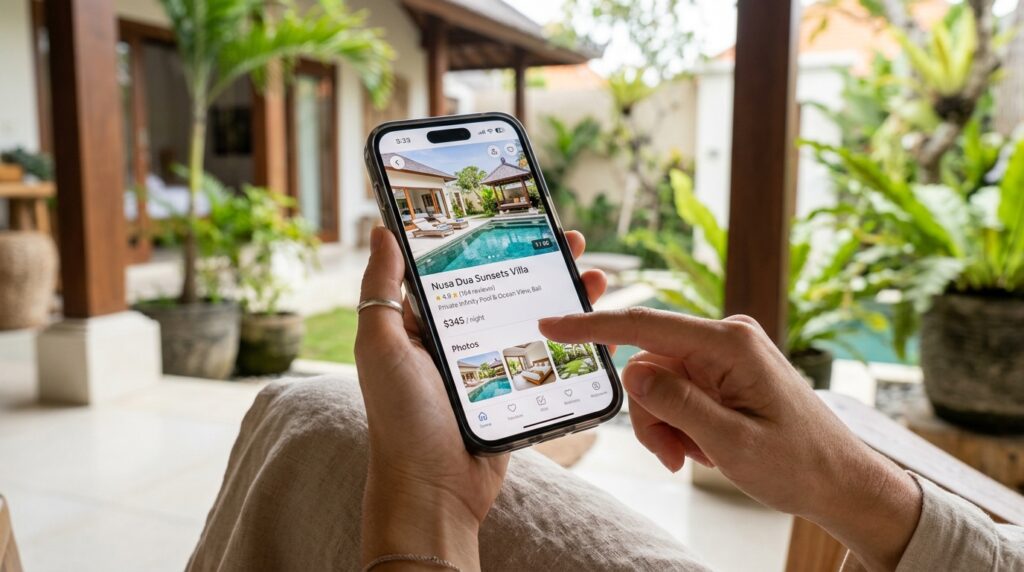

Ever feel that sinking dread when you’re about to pay for a villa, but you still can’t tell if the photos are real or if the final price will surprise you later
In this article, safe villa booking means you reduce four big worries: scams, villas that don’t match what was advertised, hidden costs that pop up at the worst time, and basic personal-security risks while you stay. The trick is that “safe” isn’t one single step. It’s a whole chain of decisions that starts before you book and continues through arrival.
Think of it as end-to-end safety. First, you do online verification so the listing actually lines up with reality. Next, you protect your payment with safeguards and clear written terms. Finally, you do on-arrival checks so you can confirm the place you walk into is the place you expected. This is why the process uses a simple three-lane approach: verify the property, protect your payment, and secure on-site safety. Let’s break down what safe really covers, and why it’s different for villas
Safe villa booking is like a multi-layer lock. Each layer is meant to stop a different kind of failure, because one single “okay” check is rarely enough in a rental market where villas can vary a lot.
Picture a house with three locks on different doors. One lock guards against scams and fraudulent listings, another protects your money from going irreversible, and the last one helps keep you secure once you’re inside. In villa terms, that means safety has three lanes: scam and fraud prevention, financial protection, and personal on-site security. The rental can be beautiful, but if the listing and reality don’t match, that mismatch is still part of the safety equation.
The main risks: what your locks are protecting against
The first lane is about scams and fraud. A bad listing might reuse photos that belong to a different place, or it might describe a villa that doesn’t exist in the real world. When that happens, you don’t just lose money, you lose time, trust, and the chance to fix the problem before your trip.
Next comes the mismatch risk. Even when a villa is real, details can be off, like the location being less convenient than promised, the “private pool” turning out to be something smaller, or key amenities not matching how they were described. That alignment between listing and reality matters because it determines whether your stay feels like what you booked, not a surprise.
Stress is the third risk lane. Hidden costs, deposits with unclear return conditions, and cancellation policies that are hard to use can create real friction. When you’re already on holiday, stress tends to push people into rushed decisions, and those rushed decisions are exactly when mistakes happen.
Online vs on-site safety keeps working after payment
Online safety is your early defense. Before you pay, you use verification steps and insist on documentation, so you can confirm the property you think you’re booking is the property you’ll actually access. Secure payment choices also matter here because they affect what recourse you have if something goes wrong.
After payment, the protection does not stop. On-site safety is where you confirm the villa matches what you agreed to and where you secure your own valuables with basic habits like locking up and using any in-villa safes available. Emergency contact readiness also belongs to this lane, because if an issue appears at night, your safety shouldn’t depend on luck or improvisation.
Now that you know what “safe” really means as a three-lane lock, let’s walk through how to apply it step by step.
Want help turning this checklist into a short, safe plan? Explore villa options and booking support on Baliexpertvillas.com.
Fraudulent listings and stolen images
Most people focus on the price, but the first real danger is fraudulent listings. A villa might not exist, or the photos might be reused from another property, making the place you arrive at feel totally different from what you paid for. In practice, that can mean money loss and a stressful scramble to fix your plans.
When a listing looks unreal, it’s a sign to treat it like a claim that needs proof. Safe booking depends on verification steps and documentation, not blind trust in images.
Misrepresentation and mismatches
Another common failure is mismatches between what’s advertised and what you actually get. The location can be farther from your expectations than described, a “private pool” can turn out smaller than the photos suggest, or amenities can be different in layout and condition. That alignment between listing and reality is part of what makes a booking feel safe, not just “real.”
Once you’re there, you may feel stuck because the villa already has your dates and your deposit assumptions, so mismatches turn into disappointment fast.
Stress from hidden fees and cancellation friction
It’s not only the villa that can go wrong. Stress often comes from hidden costs, deposits with unclear return rules, and cancellation policies that are hard to use when plans change. Even if the property is legitimate, surprises can create friction right when you want relaxation.
That’s why safe booking treats financial protection and written terms as part of the safety plan, so the “what will this cost me in reality” question has clear answers.
And here’s the part people often forget, safety continues once you book and once you arrive.
Online safety
Online safety is your pre-arrival check: verification plus documentation. You confirm the villa details make sense and you keep a written trail of what was agreed, so you are not relying on memory or vague promises
Payment safety
Payment safety is choosing secure payment and getting written terms. When the cost, deposits, and cancellation conditions are clearly documented, it is easier to handle problems without panic
On-site safety
On-site safety is what you do after you arrive: lock up, use any in-villa safes, and keep emergency contact information ready. Even if the booking was legitimate, these habits reduce the simple, everyday risks that can happen anywhere
Now let’s turn those ideas into a repeatable process.
How the safe booking process works
Imagine you’re planning your Amed dates and you need two things at once: a villa that looks right on-screen and a stay that feels right when you arrive. The safe booking process is built for that exact gap, because it reduces risk with a due diligence flow that doesn’t stop at “paid.”
In practice, you move through 4 to 6 stages: quick screening so you don’t waste time, verification so the listing matches reality, contract review so expectations become written, secure payment so you keep financial protection, and an arrival inspection so you can confirm the villa you access is the one you booked. If something seems off at any stage, you treat it as a signal to pause and verify again.
Verify the property
Start by verifying the property, not just the listing. Look for signs of fraudulent listings, like photos that seem too perfect or don’t feel tied to a specific place. The goal is to confirm the villa you think you’re booking is the villa you can actually access.
Then align what’s written with what you can check. Confirm the address on maps so the location claim makes sense, and check whether the amenities described are consistent across photos and details. If you spot mismatch patterns, treat them as risk, even if the price looks tempting.
Finally, use review signals as evidence, not decoration. Pay attention to mentions of cleanliness, staff responsiveness, and whether past guests felt the villa matched what was advertised. This is part of risk mitigation because it counters blind trust with real-world outcomes.
Lock in financial protection before paying
Before you send any money, lock in financial protection by choosing secure payment and getting written terms. A secure payment method and a clear written agreement change the situation from “it’s a guess” to “it’s documented,” which matters if you need resolution later.
Make the costs concrete. Ask for a clear breakdown of the total price and any extra charges like cleaning, deposits, utilities, or extra services. Also review the cancellation policy and deposit return conditions so you understand what happens if plans change.
When everything agreed is written down, you reduce stress because you’re not trying to negotiate from memory later. That documentation-based approach is the heart of the due diligence model, and it directly supports financial safety.
Next, let’s go from theory to the exact steps you can follow for your Amed dates.
Verify the property, not just the listing
Don’t trust the photos blindly. Check for photo authenticity by doing a reverse image concept check, and flag images that look reused or don’t appear to match the specific villa location.
Instead of asking “Are the pictures pretty,” ask “Do these pictures prove this specific place exists.” If the visuals seem generic or reused, you’re dealing with a higher risk of fraudulent listings.
Next, confirm the map and location alignment. Check the villa address on maps and compare what you see with the listing claims, especially for access and neighborhood feel in Amed.
If the location seems inconsistent with what the listing promises, you may still be able to book a real villa nearby, but you should not assume this is the same place you’re being sold.
Finally, verify consistency across info and reviews. Compare descriptions and amenity claims with review details like cleanliness, staff responsiveness, and whether the villa matched what guests expected.
Look for repeated mismatch themes in reviews, because that’s often the clearest signal that the listing and reality do not align, which leads to disappointment and stress.
Once the villa passes the reality check, then you protect yourself financially.
Lock in financial protection before paying
“Secure payment” is the goal because it gives you a chance to resolve problems instead of accepting a lost payment. Using methods with dispute options and a clear process reduces recoverability stress if anything goes wrong.
On the other hand, “irreversible transfers” can trap you. Once money is sent in a way that’s hard or impossible to reverse, you’re left with fewer options if a booking turns out to be a phantom villa or a misrepresented property.
Clear documentation is another pro. When costs, inclusions, deposits, and the cancellation policy are written down, it becomes easier to enforce what was agreed and avoid hidden-fee surprises.
Step-by-step: book with confidence in Amed
You can book a villa with confidence when you treat it like a checklist, not a leap of faith. Start by defining what you need in Amed and what “non-negotiable” means for your stay. Then you narrow options and vet reliability, not just the photos. After that, you lock in payment and paperwork safeguards so your money is protected. Finally, you arrive prepared to do a quick match check and secure valuables.
1. Narrow options and set your must-haves
First, narrow options and set your must-haves. Choose the right part of Amed for your comfort and routine, because location affects convenience and the day-to-day vibe. If you skip this, you end up comparing villas that can’t realistically meet your expectations.
Next, write down deal-breakers like Wi-Fi reliability, a kitchen that supports your cooking plans, and what you mean by “private pool.” This step reduces expectation mismatches, which is one of the fastest paths to stress. You’re not being picky, you’re preventing disappointment.
2. Vetting questions that reveal real reliability
After you narrow options, vet reliability with specific questions. Ask how check-in works and who handles access, because vague arrival details often signal sloppy management. Also confirm included services like cleaning timing and who is responsible for what during your stay.
Then drill into functionality, not buzzwords. If internet is important, ask about typical reliability for your use case. If the listing mentions amenities like kitchen equipment or pool features, ask what is actually available and how it’s maintained. This is how you catch mismatches early, before your dates are locked.
3. Payment and paperwork safeguards
Once answers look solid, move to payment and paperwork safeguards. Choose secure payment methods when possible, because they affect what you can do if something goes wrong. Avoid payment situations that are hard to trace or nearly impossible to reverse.
At the same time, get the full cost picture in writing. Confirm the total, plus deposits, cleaning fees, and any potential extra charges. Review the cancellation policy and deposit return conditions so you know what happens if plans change. Clear documentation reduces stress because it replaces guesswork with written terms.
4. Arrive prepared: inspect and secure valuables
When you arrive, do a quick match check. Compare what you see with the listing: room layout, pool condition, and the amenities you were promised. If something doesn’t line up, raise it promptly so you can resolve it while you’re still on-site.
Then secure valuables with basic on-site safety habits. Lock doors, use any available in-villa safes, and keep emergency contact information accessible. These small actions protect your personal security and help the stay feel calm, not risky.
Once you know the correct steps, it’s smart to know what people commonly get wrong.
Picture this: you’re staring at two gorgeous villas in Amed, and both look tempting, but you’re only safe if your must-haves decide the winner. When you start with requirements instead of vibes, you cut the number of options that tempt you into impulse booking.
With fewer villas to compare, you make fewer mistakes. You also spend your time on the details that actually matter, like reliability and real-world fit, not just photo angles.
Once your shortlist is small, your criteria become clearer. Pick the right location fit in Amed for your comfort and itinerary, then focus on the key amenities you truly need. This avoids that annoying gap where everything is “nice,” but it’s not right for your day-to-day life.
Finally, define deal-breakers like Wi-Fi reliability, kitchen needs, and private pool expectations. When vague amenities get replaced by specific requirements, disappointment drops fast and your booking feels grounded.
With a shortlist, you can ask smarter questions and vet reliability instead of guessing.
How does check-in and access actually work
What happens when you arrive, and who will hand you the keys or open the gate? Ask this so you know exactly how access works, especially if arrival is late or the villa is in a less central spot in Amed.
You’re also checking for staff responsibility. Clear check-in details usually match better management, while vague answers often lead to delays and stress once you’re already tired from travel.
What services are included during your stay
Which services are included, and what is the cleaning schedule? Request clarity on what the villa provides versus what costs extra, because “services included” language can be broad and inconsistent.
When you know who cleans, who responds, and what’s covered, you can avoid surprise friction. That protects your trip from stress even if the villa itself is legitimate.
Is the Wi-Fi reliable for real use
If you need the internet for work or calls, ask about typical reliability and whether it supports your needs. “Wi-Fi included” is not the same as reliable performance day to day.
Also request specifics that reflect your use case. This is how you prevent disappointment if the connection is slow, unstable, or only usable in certain areas of the villa.
How should I interpret kitchen and pool details
When the listing says a villa has a “fully equipped kitchen” or a “private pool,” ask what that means in practice. For kitchens, confirm what equipment and cooking basics are actually available for your plan.
For the pool, clarify size and expectations in simple terms. This reduces the chance of misrepresentation and mismatch, where a “private pool” turns out to be smaller or less functional than your photos made you expect.
When your questions get clear answers, you still need to lock in payment and paperwork protections.
Secure payment gateways vs irreversible transfers
A key difference is whether your payment has protection. Using a secure payment gateway can give you dispute options if a booking goes wrong, while irreversible transfers leave you with fewer ways to recover money.
Written confirmation vs verbal promises
Consider this your paper shield. When the total cost, what’s included, and any deposit terms are written down, it’s easier to enforce expectations instead of arguing from memory.
Cancellation clarity vs vague policies
Cancellation policy details determine your exit options if plans change. Clear terms also clarify how deposits are handled, so you avoid nasty surprises and stress right before or after check-in.
Even a small delay can turn into a big headache, so itemize hidden fees breakdown, confirm security deposit terms, and understand cancellation and deposit-return expectations early.
Even with good paperwork, do a quick on-arrival match check and secure your valuables.
Arrive prepared: inspect and secure valuables
When you reach the villa, do a fast match check against the listing to prevent mismatch stress. Look at the layout, the promised pool features, and the key amenities you were told to expect.
Scan the villa carefully and inspect the pool, rooms, and outdoor areas. If something looks neglected or different from what was described, note it right away so you can address discrepancies while you’re still there.
Confirm services that were included, like cleaning timing and any staff support. This helps you avoid awkward surprises later when you thought someone would be there at a specific time.
Lock doors and windows as soon as you settle in. It’s simple personal-security habits, and it reduces opportunistic theft risk even in quieter areas.
Use any available in-villa safes for passports, cash, and valuables. Keeping high-value items secure lowers the chance of losing them while you’re out snorkeling or at dinner.
Store emergency contact information before you go out. When you can reach the right people quickly, you reduce stress if anything unexpected happens at night.
Keep basic awareness around valuables after dark. Don’t leave electronics or tempting items sitting out, and you’ll feel more relaxed as soon as evening arrives.
Once you’re set, you can finally relax.
Major platform listings are automatically safe
You might assume that because a villa is shown on a big booking site, it must be verified and low-risk. That belief comes from wanting a simple safety shortcut, but it can fail when listings are misrepresented or profiles are created in a misleading way.
Instead of assuming safety, treat platform visibility as a starting point. You still need verification steps and documentation, or you may end up with a phantom villa situation or major mismatches.
Direct owner booking is always cheaper and safer
Booking direct can feel like a win, because there’s no platform fee and you’re “speaking to the real person.” The catch is that direct deals still need legitimacy checks and clear written terms.
If you pay without secure safeguards or clear documentation, recovering money becomes much harder. The result is financial risk even when the villa itself is real but the transaction was not protected.
Photos always equal the real experience
It’s easy to trust attractive images, because photos are the first thing you see. But scams and marketing misdirection both rely on imagery, including stolen pictures from other properties or edited angles that hide flaws.
When reality doesn’t match the photos, disappointment hits fast and stress rises. That’s why “photo quality” is not the same as “booking safety.”
Wiring money is just normal for international travel
People often pay by wire because it feels like a standard international method. Unfortunately, wire transfers are typically irreversible, which removes much of your ability to recover if something goes wrong.
Choosing safer payment options and getting written terms reduces that risk. When you treat money like part of safety, you avoid getting stuck.
Hidden fees and deposits blind spots
Many bookings break down after payment because hidden-fee blind spots weren’t addressed early. Cleaning charges, deposits, and utilities can reshape your total cost, and cancellation terms may be less forgiving than expected.
When you don’t itemize costs and confirm security deposit return expectations, you lose time, energy, and leverage. Planning your exit strategy early helps prevent stress even if plans change.
If you avoid those traps, you can go one step further, here are pro moves that increase confidence.
Sounds safe, but major-platform vetting is not guaranteed
It feels comforting to think a big platform means every villa is checked and protected. The reality is that listings can still be misleading, even if the page looks polished.
That belief can lead to money loss and a difficult dispute process if the villa is a phantom property or the photos come from somewhere else.
If it’s on a big platform, shouldn’t it be vetted?
Many travelers assume the platform itself has verified the exact villa, photos, and amenities. In practice, safety still depends on what you verify and what you can document.
When you skip checks, you can arrive expecting one setup and find another. That mismatch creates disappointment and makes fixes harder on your trip.
It feels smarter to book direct with the owner
Choosing direct booking can feel like a private deal with less middleman drama. Often, it can be fine, but it is not automatically safer.
If you don’t confirm legitimacy, get written terms, and choose secure payment options, you may struggle to recover funds. That’s how a “shortcut” becomes a problem.
Here’s where urgency tricks you into unsafe payment
When someone pushes for quick payment, it can override your common sense. Urgency is especially risky when they ask for hard-to-reverse transfers.
If you pay in an irreversible way, you reduce your ability to resolve issues if something goes wrong. The safest approach is to slow down and protect your transaction.
Even if you avoid scams, hidden costs and reliability gaps can still derail your trip.
Hidden-fee blind spots and expectations mismatches
Imagine you book a villa in Amed with a clear nightly rate and one total number that looks final. You feel good, so you stop thinking about costs that might change after payment.
Then, arrival day hits and the “extra” charges appear: deposits you weren’t focused on, utilities you assumed were included, and a surprise cleaning fee or taxes/service charges. If the listing implied a private pool or amenities always working, you may also notice reliability gaps like Wi-Fi, water pressure, or pool upkeep not matching the expectation.
Next, stress takes over. You end up in conflict about returns, delayed resolution, or unclear cancellation policy rules, and you waste energy on paperwork instead of enjoying your trip. To prevent this, request itemized costs in writing, review cancellation policy and deposit return conditions, and ask about essential reliability before you pay.
Pro tips to do this even better
Doing safe villa booking “good enough” is not the real win. The real win is doing it with higher confidence, even when the listing sounds perfect.
Here are two realistic mini scenarios that show why experts don’t just trust convenience. They verify reliability and plan for real-world gaps.
You message an owner and they answer fast, “Everything is included, Wi-Fi is great.” The price is attractive and the conversation stays smooth. You pay quickly, assuming it will work exactly as promised.
After that, the counterintuitive part hits. Experts ask about internet reliability in practical terms because “included” can still mean unstable or unusable for calls. That one question can prevent a miserable work or communication setup.
You’re booking a month-long stay and the villa looks perfect on photos. Ten days in, the power flickers during peak evening hours and the water pressure drops. You’re annoyed because the listing didn’t mention the day-to-day reality.
To avoid that, higher-confidence travelers ask about power backup and essential reliability issues before paying. They also use an advanced technique: book a short inspection stay nearby first, so you can validate what you actually experience before committing long-term.
Questions experts ask about reliability
When reliability matters, ask targeted questions that reveal the failure mode. For internet, ask about typical performance for your use case, not just whether Wi-Fi exists. For power, ask what happens during outages so you know if the villa can keep functioning.
In the background, you’re also accounting for environmental realities like noise and small infrastructure issues. Experts treat these as normal variables, not surprises.
A safer strategy for long stays
If you’re committing to a longer stay, reduce risk by validating reality first. A short initial stay nearby helps you inspect the villa and its micro-location in person before you lock into a longer timeline.
Then you decide with an exit-strategy mindset. If essentials don’t match, clear cancellation and deposit-return expectations become your safety net.
Let’s turn those pro ideas into specific questions you can copy-paste.
Internet reliability question
For internet, ask “What is the usual speed and reliability of Wi-Fi for video calls?” You’re uncovering whether the connection stays usable, not just whether a router exists.
This reduces stress because you can plan around real performance. If it’s slow, you learn before you book, instead of during your work or communication days.
Electricity and power backup question
For power, ask “What happens during power outages, and is there any backup support?” You’re checking stability and response, since electricity dips can affect comfort and key amenities.
Knowing what to expect prevents surprises. It also helps you avoid an expectation mismatch when daily life depends on reliable power.
Day-to-day environment realities question
For the neighborhood, ask “Is there any regular early-morning noise like roosters or nearby activities?” You’re looking for environmental realities that listings rarely describe clearly.
When you understand the day-to-day soundscape, you can adjust your plans. That makes the stay feel safer and calmer, even when the villa itself is perfectly legitimate.
If you’re booking longer, there’s an even safer way to validate reality.
Commit long-term based on photos
Picture this: you find a perfect villa on photos and you lock in a long stay right away. That saves time, but it increases the risk that real conditions, like Wi-Fi, water pressure, or pool upkeep, won’t match the listing.
So the trade-off is speed over confidence. If the villa is off by even a little, you can end up stressed while trying to adjust during your stay.
Use a short inspection stay first
Alternatively, you book a short inspection stay nearby before committing long-term. This reduces risk because you verify the micro-location and daily reality in person, instead of guessing from photos.
The cost is a bit of time and planning, but the confidence is higher. You also get clearer evidence for any exit strategy if essentials don’t match.
When you compare these options, decide based on your exit strategy awareness. Match your decision to cancellation and deposit-return expectations so you’re not trapped if reliability gaps appear.
Your checklist for a safe Amed villa stay
“Safe” means three lanes: verify property, protect payment, and secure on-site safety.
Verify the villa so the listing and reality match, including location and amenities.
Use secure payment methods and get written terms for costs, deposits, and included services.
Review the cancellation policy and deposit return expectations before you pay.
Do an arrival match check so you can spot discrepancies early.
Lock doors and windows, and use any in-villa safes for passports, cash, and valuables.
Save emergency contact information so you’re not searching when stress hits.
If reliability matters to your trip, ask about internet performance, power stability, and day-to-day noise realities.
Ready to book with confidence in Amed? Share your dates and preferences with Baliexpertvillas.com so the next step is clear.
You’ll know exactly what to ask, and that’s what lets you relax.